Eye Evolution
Eye Evolution: How Nature Perfected the Sense of Sight
Have you ever stopped to think about how truly incredible your eyes are? They capture light, focus images, distinguish millions of colors, and process vast amounts of data—all in real-time. It's a biological masterpiece.
For decades, the complexity of the eye has been used by skeptics to question the principles of gradual evolution. After all, what good is half an eye? But modern biology and paleontology have shown us a stunning, step-by-step path detailing exactly how this magnificent organ came to be. This is the story of Eye Evolution.
Why Eye Evolution Matters
Understanding Eye Evolution isn't just a fascinating academic exercise; it's one of the best examples of natural selection at work. It demonstrates how seemingly impossible complexity can arise through tiny, successive improvements over vast stretches of geological time.
The first steps toward sight didn't require perfection. They only required a competitive edge. Even a small ability to detect the presence or absence of light provided an organism with a massive advantage—it could find sunlight for food, or hide in shadows from predators.
We're talking about more than 500 million years of refinement, dating back to the Cambrian Explosion. During this period, organisms developed all the basic components we see today, from light receptors to complex lenses. Let's delve into the elegant path taken by nature.
The Simple Start: From Light Patches to Complex Lenses
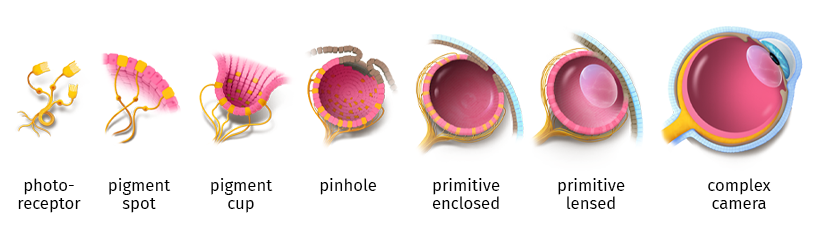
The journey from simple light sensitivity to high-resolution vision is often broken down into intermediate stages. These stages demonstrate that every step, no matter how minor, offered a clear benefit to the organism that possessed it.
This process of Eye Evolution proves that no "magic jump" was required. Instead, minor genetic mutations that improved light detection were favored by selection, leading to greater complexity.
Stage 1: The Light-Sensitive Patch
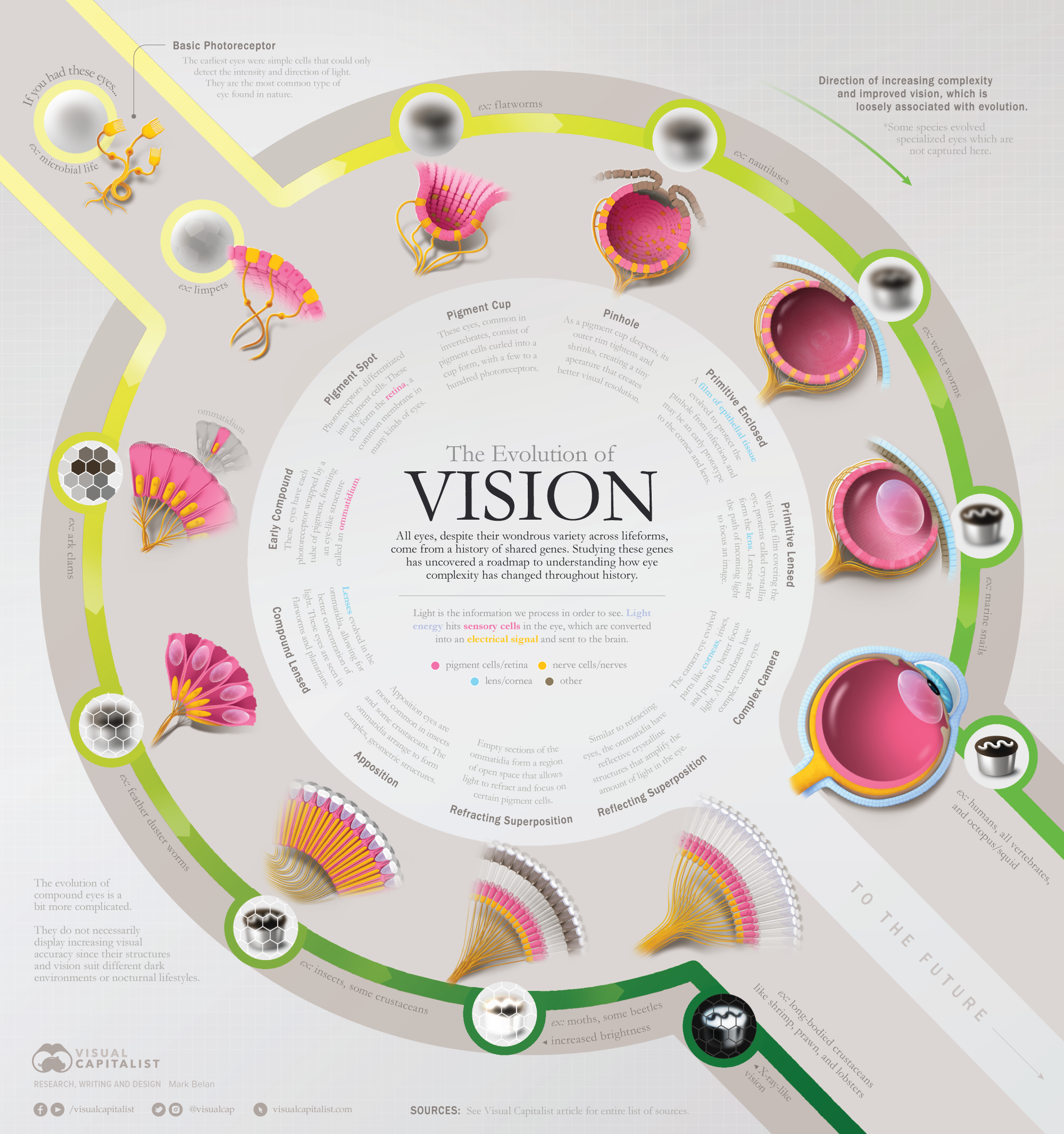
The earliest form of an eye was incredibly rudimentary. Think of it as a simple collection of photoreceptor cells, sensitive only to light intensity. Organisms like flatworms and single-celled life still possess versions of this simple patch today.
This patch could tell the organism if it was bright or dark. Crucially, it couldn't see shapes or details, but it allowed the organism to detect the direction of a light source, aiding in movement toward food or away from danger.
This stage laid the essential groundwork. The critical components needed for all future forms of eyes—photopigments (like rhodopsin) and the neurons to process the signal—were already in place.
Stage 2: The Pinhole Camera Eye
The next major evolutionary step involved the light-sensitive patch beginning to fold inwards, forming a cup shape. This small change had enormous consequences for Eye Evolution.
By recessing the cells, the opening became smaller, creating what is known as a "pinhole camera." This arrangement allows for crude image formation. Although the image is dim, the organism can now detect the direction of light with much greater precision and even distinguish basic shapes or shadows.
Nautiluses, deep-sea creatures related to squid, still use a functioning pinhole eye today. This structure eliminated the need for complex focusing structures initially, showing how simple geometric changes can lead to functional vision.
Stage 3: The Camera-Type Eye
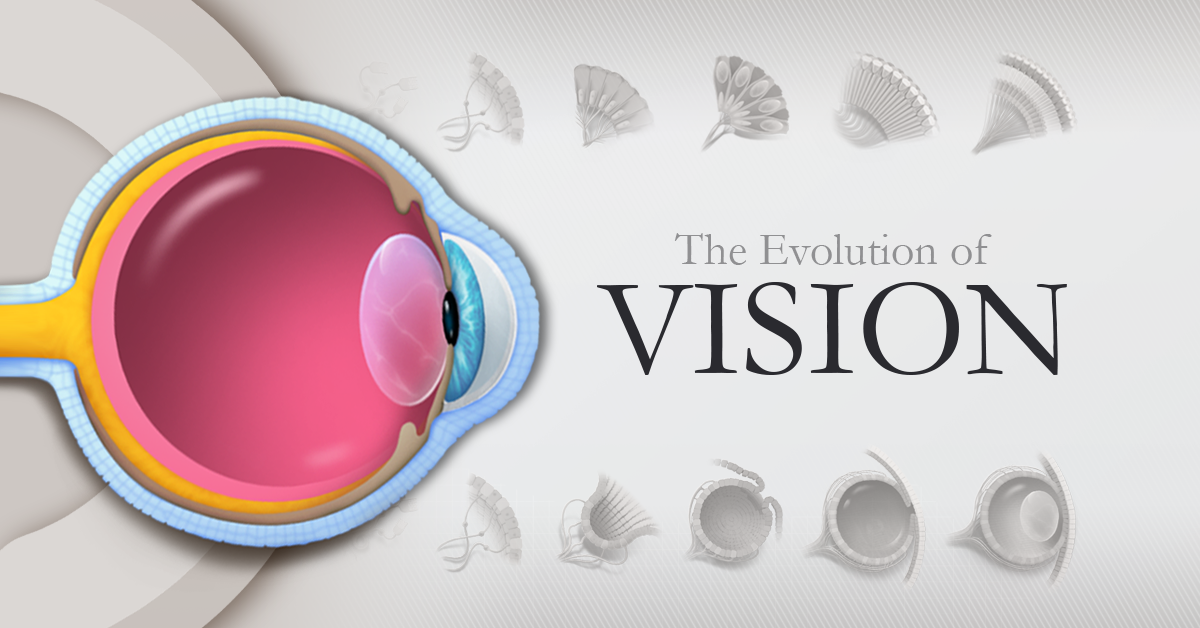
The final, most sophisticated stage involved sealing the opening and filling the cup with a transparent gel, followed by the development of a lens. This structure is what we, and animals like squid and fish, possess.
Why is the lens so revolutionary? It solves the problem inherent in the pinhole eye: dimness. The lens gathers a tremendous amount of light and focuses it sharply onto the retina, providing both brightness and high-resolution imaging.
The development of crystallins, the transparent proteins that make up the lens, is a fantastic story in itself. These proteins were originally used for basic cellular functions before being co-opted for their light-bending properties in the eye. Evolution often repurposes existing biological components.
A Spectrum of Vision: Different Eyes for Different Lives
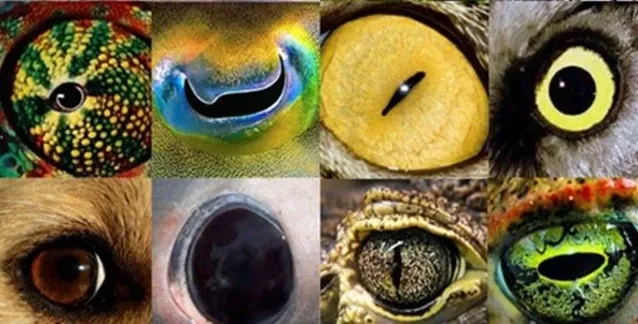
When studying Eye Evolution, it is crucial to remember that evolution does not strive for a single "perfect" solution. It creates solutions optimized for specific environments and lifestyles. This is why the natural world is full of radically different eyes.
Compound Eyes vs. Single-Lens Eyes
The two major eye types dominate the animal kingdom, each optimized for different needs.
Our camera-type eyes (single-lens) excel at high resolution and detail, which is necessary for identifying distant objects or reading a book. However, the eyes of insects and crustaceans are built differently.
Compound eyes, found in flies and bees, are composed of thousands of individual, tiny light-gathering units called ommatidia. While they offer lower spatial resolution than ours, they have unparalleled advantages in specific areas:
- Motion Detection: Compound eyes are incredibly sensitive to movement, allowing insects to react rapidly to threats or catch fast-moving prey.
- Wide Field of View: They often offer nearly 360-degree vision, essential for vulnerable creatures.
- Polarized Light: Many arthropods can detect polarized light, which they use for navigation, a feat humans cannot naturally achieve.
Examples of Extreme Eye Evolution
Some creatures have pushed the limits of sight to truly astonishing extremes, demonstrating the incredible flexibility of the evolutionary path.
Consider the Mantis Shrimp. These creatures possess the most complex eyes known to science. They have 12 to 16 types of photoreceptor cones (humans only have three!), allowing them to see hyper-spectral colors, ultraviolet, and even circular polarized light. This complexity likely helps them communicate via color displays and hunt their armored prey.
Or look at the Scallop. Though sedentary, the scallop is equipped with dozens of tiny, functional eyes lining the edge of its mantle. Unlike ours, these eyes use a reflective mirror instead of a lens to focus light, proving that the solution to focusing light can evolve in fundamentally different ways.
Debunking the Critics: The Logic of Incremental Change
The core argument against Eye Evolution—that an eye is only useful if it's complete—is fundamentally flawed. Mathematical models, pioneered by scientists like Dan-Eric Nilsson, confirm that the entire evolutionary process from a simple light patch to a fully functioning camera eye can occur in remarkably short geological time, requiring only tiny, functional steps.
The key takeaway is that every mutation that provides a marginally better view is favored. A creature that can vaguely sense a predator shadow is much more likely to survive than one that cannot see anything at all.
Therefore, we see a chain of continuous improvement, where the pressure to survive drives the constant refinement of light-gathering and image-processing capabilities. The magnificent complexity of the eye is merely the result of countless generations optimizing their survival odds.
Conclusion
The story of Eye Evolution is one of nature's greatest triumphs. Far from being an insurmountable challenge to evolutionary theory, the eye serves as a powerful example of how simple beginnings, combined with immense time and relentless natural selection, can lead to staggering complexity. From the humble light-sensitive patch of early life to the high-resolution, multi-spectrum vision systems we see today, the evolution of sight is a continuous, logical, and breathtaking process.
It's a reminder that sometimes, the most sophisticated designs are built one small, advantageous step at a time. The next time you look at the world, take a moment to appreciate the incredible, 500-million-year journey your eyes took to get here.
Frequently Asked Questions (FAQ) about Eye Evolution
- What was the first type of eye to evolve?
- The first eye structure was the light-sensitive patch, a collection of photoreceptor cells capable only of detecting light intensity and direction, not image detail.
- How long did it take for the camera-type eye to evolve?
- Mathematical models suggest that the physical transition from a simple light patch to a complex camera-type eye (similar to ours) could have taken less than 400,000 years, given constant, incremental selection pressure. This is a very short time in evolutionary terms.
- Did eyes evolve only once?
- No. While all eyes share a common genetic foundation (the regulatory gene Pax6), complex, fully functional eyes have evolved independently at least 40 to 60 times across different lineages, leading to structures like single-lens eyes, compound eyes, and reflective eyes (like those found in scallops).
- What is the significance of the Pax6 gene in Eye Evolution?
- The Pax6 gene is often referred to as the "master control gene" for eye development. It is found across almost all animals that have eyes (from flies to humans). This suggests that the fundamental genetic instructions for 'building an eye' were present very early in animal evolution, even before the physical structure of the eye diversified.
Eye Evolution
Eye Evolution Wallpapers
Collection of eye evolution wallpapers for your desktop and mobile devices.
Exquisite Eye Evolution View Collection
Find inspiration with this unique eye evolution illustration, crafted to provide a fresh look for your background.

Beautiful Eye Evolution Landscape Photography
Transform your screen with this vivid eye evolution artwork, a true masterpiece of digital design.
Stunning Eye Evolution Photo for Your Screen
This gorgeous eye evolution photo offers a breathtaking view, making it a perfect choice for your next wallpaper.
Exquisite Eye Evolution Wallpaper Photography
A captivating eye evolution scene that brings tranquility and beauty to any device.
Beautiful Eye Evolution Design Concept
Experience the crisp clarity of this stunning eye evolution image, available in high resolution for all your screens.
Stunning Eye Evolution Background Nature
A captivating eye evolution scene that brings tranquility and beauty to any device.
Detailed Eye Evolution Artwork Art
Discover an amazing eye evolution background image, ideal for personalizing your devices with vibrant colors and intricate designs.
Detailed Eye Evolution Artwork Collection
Transform your screen with this vivid eye evolution artwork, a true masterpiece of digital design.
Dynamic Eye Evolution Capture Collection
This gorgeous eye evolution photo offers a breathtaking view, making it a perfect choice for your next wallpaper.

Vibrant Eye Evolution Design Collection
Experience the crisp clarity of this stunning eye evolution image, available in high resolution for all your screens.
Breathtaking Eye Evolution Photo Collection
Explore this high-quality eye evolution image, perfect for enhancing your desktop or mobile wallpaper.
Serene Eye Evolution Image for Mobile
Discover an amazing eye evolution background image, ideal for personalizing your devices with vibrant colors and intricate designs.

Stunning Eye Evolution Photo for Your Screen
Immerse yourself in the stunning details of this beautiful eye evolution wallpaper, designed for a captivating visual experience.

Detailed Eye Evolution Design for Desktop
Discover an amazing eye evolution background image, ideal for personalizing your devices with vibrant colors and intricate designs.
Detailed Eye Evolution Moment for Desktop
Transform your screen with this vivid eye evolution artwork, a true masterpiece of digital design.

Spectacular Eye Evolution Background for Mobile
Find inspiration with this unique eye evolution illustration, crafted to provide a fresh look for your background.

Amazing Eye Evolution Scene Art
Explore this high-quality eye evolution image, perfect for enhancing your desktop or mobile wallpaper.

Serene Eye Evolution View for Desktop
Transform your screen with this vivid eye evolution artwork, a true masterpiece of digital design.

Spectacular Eye Evolution Wallpaper Concept
This gorgeous eye evolution photo offers a breathtaking view, making it a perfect choice for your next wallpaper.
Crisp Eye Evolution Picture Photography
Find inspiration with this unique eye evolution illustration, crafted to provide a fresh look for your background.
Download these eye evolution wallpapers for free and use them on your desktop or mobile devices.
0 Response to "Eye Evolution"
Post a Comment